Some of the policy from the app automation refers to https://rclone.org/privacy/ if you are a general blog reader, follow Google's policy please
Monday, December 22, 2025


Wednesday, December 27, 2023
Ranking and Unranking permutations
I've been a big fan of Skiena's Algorithm Design Manual, I recently found my first edition of the book (although I own the third edition), I felt guilty for not using and started with the much more compact first edition. I do run into errata, but being able to discover it on my own and see it fixed in the new editions, provides a lot of satisfaction :)
One of the commonly used algorithms for combinatorics is ranking and unranking of permutations. The algorithm provided in the book is derived from the Combinatorica package. The book provides an example or two, which is quite terse, so I decided to implement things myself. There is a slightly better explanation in Computational Discrete Mathematics, also written by the same author.
Here is my python implementation of the rank/unrank algorithm(s)
1 2 3 4 5 6 7 8 9 10 11 12 13 14 15 16 17 18 19 20 21 22 23 24 25 26 27 28 29 30 31 32 | import functools @functools.lru_cache(maxsize=None) def fact(n): if n == 1 or n == 0: return 1 else: return n*fact(n-1) assert fact(5) == 120 assert fact(0) == 1 #@param perm - given a permutation as an array, calculate it's rank def rank(perm): if not isinstance(perm, list): raise "Invalid input" else: n = len(perm) if n == 0 or (n == 1 and perm[0] == 1): return 0 rest = list(map(lambda x: x - 1 if x > perm[0] else x, perm[1:])) return (perm[0]-1) * fact(n-1) + rank(rest) #@param n, k - given rank k of an n element permutation, print it def unrank(k, n, perm): q, r = divmod(k, fact(n - 1)) perm[0] = q + 1 if n == 1: return [perm[0]] rest = perm[1:] newperm = unrank(r, n - 1, rest) rest = list(map(lambda x: x+1 if x >= perm[0] else x, newperm)) return [perm[0]] + rest |
Here are some simple tests and their output
for i in range(24):
perm=[0 for i in range(4)]
perm=unrank(i, 4, perm)
print(perm, "->", rank(perm))
perm=[0 for i in range(4)]
perm=unrank(i, 4, perm)
print(perm, "->", rank(perm))
Eyeballing them, they look right to me
Next steps:
Rosetta Code Ranking of Permutations has a comprehensive implementation of ranking/unranking algorithms, including iterative implementations. I would recommend moving to these set as they can be much more performant
Sunday, March 27, 2022
Introduction to Algorithms Fourth Edition (almost out, so is the code)
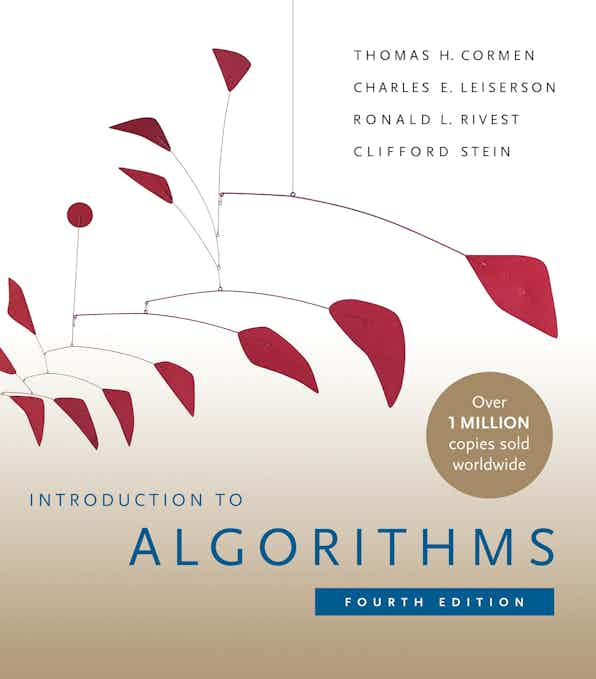
The book is almost out there. There is code and selected solutions as well. The book is supposed to be in full colour from what I heard. What do you think of the code? There is an interesting interview as well.
Defer style programming in C
It's a well known trick, but I loved the ability to defer functions in golang. In C, gcc provides an attribute for cleanup. I posted a pull request for the libcgroup. Turns out systemd has something similar, but I do like that the attributes have implicit functions and the overall design seems cleaner. I do not like dereferencing a double void star pointer though.
More details can be found in the pull request
Sunday, November 28, 2021
Test Driven Development
I've been learning rust programming language. The addition of the ability to write tests in-built is quite a welcome change to most programming languages. I found that I spent a lot of time debugging corner cases (bounds) in my algorithms, so I decided to do a test driven approach (not a chaos/random approach), but more targetted towards my weakness with boundary conditions. My favourite small/short/complex algorithm is quicksort.
Here is the code I wrote
use std::cmp::PartialOrd;
/// Quicksort
/// Simple sort algorithm that is type aware and is unique in that it's test driven
///
fn partition<T: PartialOrd>(elements: &mut [T], low: usize, high: usize) -> usize {
// Explictly set the pivot to the lowest element
let mut i : usize;
let mut j : usize;
if high <= low {
return low;
}
i = low; j = high -1; // Bounds 1, check
while i < j {
while elements[i] <= elements[low] && i < (high-1) { i = i + 1; } // Bounds 2
while elements[j] >= elements[low] && j > low { j = j - 1; } // Bounds 3
if i >= j {break; } // Bounds 4
elements.swap(i, j); // Check 5
}
elements.swap(low, j); // Check 6
j
}
fn __quicksort<T: PartialOrd + std::fmt::Debug>(elements: &mut [T], low: usize, high: usize)
{
let p = partition(elements, low, high);
if p > low {
__quicksort(elements, low, p);
}
if p < high {
__quicksort(elements, p+1, high);
}
}
fn quicksort<T: PartialOrd + std::fmt::Debug>(elements: &mut [T])
{
let len = elements.len();
__quicksort(elements, 0, len);
}
#[test]
fn partition_bounds_test_single()
{
let mut elements = vec![1];
assert_eq!(0, partition(&mut elements, 0, 1));
}
#[test]
fn partition_bounds_test_mostly_sorted()
{
let mut elements = vec![10, 2, 4, 5, 6];
let expected = vec![6, 2, 4, 5, 10];
let len = elements.len();
assert_eq!(4, partition(&mut elements, 0, len));
assert_eq!(expected, elements);
let mut elements = vec![2, 4, 5, 6, 10];
let expected = vec![2, 4, 5, 6, 10];
let len = elements.len();
assert_eq!(0, partition(&mut elements, 0, len));
assert_eq!(expected, elements);
}
#[test]
fn partition_bounds_test_2_elements_sorted()
{
let mut elements = vec![15, 10];
let expected = vec![10, 15];
let len = elements.len();
assert_eq!(1, partition(&mut elements, 0, len));
assert_eq!(expected, elements);
let mut elements = vec![10, 15];
let expected = vec![10, 15];
let len = elements.len();
assert_eq!(0, partition(&mut elements, 0, len));
assert_eq!(expected, elements);
let mut elements = vec![15, 5, 10];
let expected = vec![10, 5, 15];
let len = elements.len();
assert_eq!(2, partition(&mut elements, 0, len));
assert_eq!(expected, elements);
}
#[test]
fn quicksort_test()
{
let mut vec = vec![1, 5, 10, 2, 15];
let mut vec2 = vec.clone();
quicksort(&mut vec);
vec2.sort();
assert_eq!(vec![1, 2, 5, 10, 15], vec);
assert_eq!(vec2, vec);
let mut vec = vec![1.1, 1.15, 5.5, 1.123, 2.0];
quicksort(&mut vec);
assert_eq!(vec, vec![1.1, 1.123, 1.15, 2.0, 5.5]);
let mut vec = vec![1, 5, 10, 15, 2];
let mut vec2 = vec.clone();
quicksort(&mut vec);
vec2.sort();
assert_eq!(vec2, vec);
let mut vec = vec![15, 5, 10];
let mut vec2 = vec.clone();
quicksort(&mut vec);
vec2.sort();
assert_eq!(vec2, vec);
let mut vec = vec![1, 2, 3, 4, 5];
let mut vec2 = vec.clone();
quicksort(&mut vec);
vec2.sort();
assert_eq!(vec2, vec);
let mut vec = vec![5, 4, 3, 2, 1];
let mut vec2 = vec.clone();
quicksort(&mut vec);
vec2.sort();
assert_eq!(vec2, vec);
}
Notice, the identification of the various conditions as bounds with a number in the partition algorithm. Looking at the algorithm, the following caught my attention
- The use of the parameter high in the algorithm is unique, high is always one greater than the last element, so should the contract abstract it and expect a pointer to the last element? Notice the use of high-1 more than once in the code.
- Rust itself has some quirks associated with the Borrow Checker, after taking a mutable reference to the vector, one cannot use elements.len(), since that internally grabs a shared reference (the compiler tells you).
- The while loops use elements[i] <= elements[low], even though elements[low] is constant, using it before the loop causes a move of the element to the temporary variable used to cache it and that causes the Borrow Checker to complain, it might be possible to do some interesting things by having the template type T have a constraint that requires it to implement the Copy trait.
- Typically quicksort partitions the elements at p and do a quicksort with 0, p-1 and p+1 to high, but since the bounds is [low, high), we need to ensure we pass p as oposed to p-1
To deal with the complexity of the algorithm (points 1 through 4 above), I decided to use a test driven
approach and tried to cover as many cases as I could think off and extracted coverage.
(you need the nightly compiler for it).
Here is what the output looks like
    1|      1|use std::cmp::PartialOrd;use std::cmp::PartialOrd;
    2|       |
    3|       |/// Quicksort
    4|       |/// Simple sort algorithm that is type aware and is unique in that it's test driven
    5|       |///
    6|     49|fn partition<T: PartialOrd>(elements: &mut [T], low: usize, high: usize) -> usize {
    7|     49|    // Explictly set the pivot to the lowest element
    8|     49|    let mut i : usize;
    9|     49|    let mut j : usize;
   10|     49|
   11|     49|    if high <= low {
   12|     15|        return low;
   13|     34|    }
   14|     34|
   15|     34|    i = low; j = high -1; // Bounds 1, check
   16|       |
   17|     37|    while i < j {
   18|     63|        while elements[i] <= elements[low] && i < (high-1) { i = i + 1; } // Bounds 2
                                                            ^45          ^36
   19|     65|        while elements[j] >= elements[low] && j > low { j = j - 1; } // Bounds 3
                                                            ^50     ^38
   20|       |
   21|     27|        if i >= j {break; } // Bounds 4
                                 ^24
   22|      3|
   23|      3|        elements.swap(i, j); // Check 5
   24|       |    }
   25|     34|    elements.swap(low, j); // Check 6
   26|     34|    j
   27|     49|}
   28|       |
   29|     43|fn __quicksort<T: PartialOrd + std::fmt::Debug>(elements: &mut [T], low: usize, high: usize)
   30|     43|{
   31|     43|    let p = partition(elements, low, high);
   32|     43|    // p - 1 should not be negative
   33|     43|    if p > low {
   34|      9|        __quicksort(elements, low, p);
   35|     34|    }
   36|     43|    if p < high {
   37|     28|        __quicksort(elements, p+1, high);
   38|     28|    }
                   ^15
   39|     43|}
   41|      6|fn quicksort<T: PartialOrd + std::fmt::Debug>(elements: &mut [T])
   42|      6|{
   43|      6|    let len = elements.len();
   44|      6|
   45|      6|    __quicksort(elements, 0, len);
   46|      6|}
Not bad, but the branch coverage needs improvement. This variant of quicksort is prone to several errors, although it might seem faster at first look. Interestingly, the algorithms book by Jeff Erickson very correctly states
Hoare proposed a more complicated “two-way” partitioning algorithm that has some practical advantages over Lomuto’s algorithm. On the other hand, Hoare’s partitioning algorithm is one of the places off-by-one errors go to die
I do find the Lomuto's algorithm easier to parse and implement. What do you think? Is test-driven iterative development the right way forward for even things like data structures? What's the best way to compute the total number of branches and cover them? Should we search for easier alternatives that perform well and are easier to test?
Update: I made some slice based improvements to the code, with the Lomuto algorithm as well
/// Quicksort
/// Simple sort algorithm that is type aware and is unique in that it's test driven
///
fn partition<T: PartialOrd>(elements: &mut [T]) -> usize {
    // Explictly set the pivot to the lowest element
    let mut i : usize;
    let mut j : usize;

    if elements.is_empty() { // Bounds 1
        return 0;
    }

    let high = elements.len();

    i = 0;
    j = high - 1;

    while i < j { // Bounds 2
        while elements[i] <= elements[0] && i < (high-1) { i += 1; } // Bounds 3
        while elements[j] >= elements[0] && j > 0 { j -= 1; } // Bounds 4

        if i >= j {break; } // Bounds 5

        elements.swap(i, j); // Check 6
    }
    elements.swap(0, j); // Check 7
    j
}

fn quicksort<T: PartialOrd + std::fmt::Debug>(elements: &mut [T])
{
    let low = 0;
    let high = elements.len();

    if elements.is_empty() {
        return;
    }

    let p = partition(&mut elements[low..high]);
    // p - 1 should not be negative
    quicksort(&mut elements[low..p]);
    quicksort(&mut elements[p+1..high]);
}
/// Use the algorithm that has fewer boundary conditions to worry about
fn lomuto_partition<T: std::cmp::PartialOrd>(elements: &mut [T]) -> usize
{
let mut i: usize = 0;
let size: usize = elements.len();
let mut j : usize = 0;
if elements.is_empty() { // bounds 1
return 0;
}
while i < size-1 { // bounds 2
i += 1;
if elements[i] <= elements[0] { // bounds 3
j += 1;
elements.swap(i, j); // bounds 4
}
}
elements.swap(0, j); // bounds 5
j
}fn quicksort<T: PartialOrd + std::fmt::Debug>(elements: &mut [T])
{
let low = 0;
let high = elements.len();
if elements.is_empty() {
return;
}
let p = lomuto_partition(&mut elements[low..high]);
// p - 1 should not be negative
quicksort(&mut elements[low..p]);
quicksort(&mut elements[p+1..high]);
}
Sunday, June 07, 2020
Volume of a unit hyper sphere of radius 1
Inspired by foundations of data science, the area of a circle is
\( \int_{x=-1}^{x=1}\int_{y=-\sqrt{1-x^2}}^{y=\sqrt{1-x^2}}dydx \)
This further extended to a sphere is
\(\ int_{x=-1}^{x=1}\int_{y=-\sqrt{1-x^2}}^{y=\sqrt{1-x^2}}\int_{z=-\sqrt{1-x^2-y^2}}^{z=\sqrt{1-x^2-y^2}}dzdydx \)
This when implemented via maxima is
(%i17) integrate(integrate(integrate(1, z, -sqrt(1-x^2-y^2), sqrt(1-x^2-y^2)),
y, -sqrt(1-x^2), sqrt(1-x^2)), x, -1, 1);
Maxima goes on to ask if
"Is "(x-1)*(x+1)" positive or negative?"For a circle this value is definitely negative and voila we get the answer as $4\pi/3$. Higher dimenisons lead to interesting results
For 4 dimensions, we use
integrate(integrate(integrate(integrate(1, x4, -sqrt(1-x1^2-x2^2-x3^2),
sqrt(1-x1^2-x2^2-x3^2)), x3, -sqrt(1-x1^2-x2^2),
sqrt(1-x1^2-x2^2)), x2, -sqrt(1-x1^2), sqrt(1-x1^2)),
x1, -1, 1);
and get the volume as $\pi^2/2$ as the answer which matches what the book predicts
Saturday, May 30, 2020
Passive reaction: Computer Science has changed/changing
In their book Foundations of Data Science, the authors state in the preface that:
"Courses in theoretical computer science covered finite automata, regular expressions, context-free languages, and computability. In the 1970’s, the study of algorithms was added as an important component of theory. The emphasis was on making computers useful. Today, a fundamental change is taking place and the focus is more on a wealth of applications. There are many reasons for this change. The merging of computing and communications has played an important role. The enhanced ability to observe, collect, and store data in the natural sciences, in commerce, and in other fields calls for a change in our understanding of data and how to handle it in the modern setting. The emergence of the web and social networks as central aspects of daily life presents both opportunities and challenges for theory.
While traditional areas of computer science remain highly important, increasingly researchers of the future will be involved with using computers to understand and extract usable information from massive data arising in applications, not just how to make computers useful on specific well-defined problems. With this in mind we have written this book to cover the theory we expect to be useful in the next 40 years, just as an under standing of automata theory, algorithms, and related topics gave students an advantage in the last 40 years. One of the major changes is an increase in emphasis on probability, statistics, and numerical methods.
...
Modern data in diverse fields such as information processing, search, and machine learning is often advantageously represented as vectors with a large number of components"
Sounds like I am a student of the past that focused more on Automata Theory and algorithms (traditional) in the past. I am yet to catch up with the mentioned emergence and opportunities topics. Time to learn new things, but it's going to be tricky to do it by myself, but I am glad to see someone thinking of the next 40 years.
"Courses in theoretical computer science covered finite automata, regular expressions, context-free languages, and computability. In the 1970’s, the study of algorithms was added as an important component of theory. The emphasis was on making computers useful. Today, a fundamental change is taking place and the focus is more on a wealth of applications. There are many reasons for this change. The merging of computing and communications has played an important role. The enhanced ability to observe, collect, and store data in the natural sciences, in commerce, and in other fields calls for a change in our understanding of data and how to handle it in the modern setting. The emergence of the web and social networks as central aspects of daily life presents both opportunities and challenges for theory.
While traditional areas of computer science remain highly important, increasingly researchers of the future will be involved with using computers to understand and extract usable information from massive data arising in applications, not just how to make computers useful on specific well-defined problems. With this in mind we have written this book to cover the theory we expect to be useful in the next 40 years, just as an under standing of automata theory, algorithms, and related topics gave students an advantage in the last 40 years. One of the major changes is an increase in emphasis on probability, statistics, and numerical methods.
...
Modern data in diverse fields such as information processing, search, and machine learning is often advantageously represented as vectors with a large number of components"
Sounds like I am a student of the past that focused more on Automata Theory and algorithms (traditional) in the past. I am yet to catch up with the mentioned emergence and opportunities topics. Time to learn new things, but it's going to be tricky to do it by myself, but I am glad to see someone thinking of the next 40 years.
Sunday, November 03, 2019
Frustration with the state of math in schools
I remember growing up and enjoying math in class. The learning method used in school was not very exploratory, but my dad (who was a genius in my opinion) made it a lot of fun. My dad was very protective also about what I learnt, I used to look at my elder brothers book and learn calculus in grade 8, but my dad suggested that the wrong background would lead me down to a path of losing interest. I guess he was right, but then by 8th grade I was able to calculate square and cube roots using the Newton Raphson method.
NOTE: I had learnt the formula for squares and cubes without necessarliy mastering how we arrived at the differential, it was algorithm/formula for me to follow
My frustration is with the math of today, some with the teachers where I put my son for some extra classes and he was asked to remember formulae without detailed concepts. I see why those topics are important, but it seems like:
NOTE: I had learnt the formula for squares and cubes without necessarliy mastering how we arrived at the differential, it was algorithm/formula for me to follow
My frustration is with the math of today, some with the teachers where I put my son for some extra classes and he was asked to remember formulae without detailed concepts. I see why those topics are important, but it seems like:
- Teachers who want to clarify concepts and teach nicely are too slow in catching up with topics to be covered
- Teachers catching up with topics and keeping good pace, don't spend enough time on concepts
Short of explaining everything to my son and writing a book or blog posts it's going to be hard to find a balance. I have some hope in the form of Khan Academy, but my son is not too interested in it at the moment.
If someone has pointers to great graphics/programs that can help, please do. Otherwise, I'll try and cover ratio and proportions for my first post.
Sunday, July 09, 2017
Dynamic programming for the binomial coefficient
More fun things, this time with some visualisation of what happens when memoisation is used and what happens when we don't. I don't these these algorithms are the most efficient algorithms
#
# dynamic programming for binomial co-efficient
#
def dynamic_bc(n, k, indent=0):
    #
    # return (n k) using dynamic programming
    # tail cases are k == 0 or k == 1
    # (n 0) = 1 and (n 1) = n
    for i in range(0, indent):
        print " ",
    print "%d:%d" %(n, k)
    if (k == 0):
        arr[n][k] = 1
        return 1
    if (k == 1):
        arr[n][k] = n
        return n
    if (n == k):
        arr[n][k] = 1
        return 1
    # (n k) = (n!)/(n-k)!k!, lets split it further
    # n!/(n-k)!k! = n(n-1)!/(n-k)!k(k-1)!
    # or (n k) = (n-1 k) + (n -1 k-1)
    if (arr[n-1][k-1] == 0):
        arr[n-1][k-1] = dynamic_bc(n-1,k-1,indent+1)
    if (arr[n-1][k] == 0):
        arr[n-1][k] = dynamic_bc(n-1, k,indent+1)
    return arr[n-1][k] + arr[n-1][k-1]

def bc(n, k, indent=0):
    #
    # tail cases are k == 0 or k == 1
    # (n 0) = 1 and (n 1) = n
    for i in range(0, indent):
        print " ",
    print "%d:%d" %(n, k)
    if (k == 0):
        return 1
    if (k == 1):
        return n
    if (n == k):
        return 1
    # (n k) = (n!)/(n-k)!k!, lets split it further
    # n!/(n-k)!k! = n(n-1)!/(n-k)!k(k-1)!
    # or (n k) = (n-1 k) + (n -1 k-1)
    return bc(n-1,k,indent+1) + bc(n-1,k-1,indent+1)

number = 6
select = 3
arr = [[0 for x in range(0, number)] for x in range(0, number)]

print bc(number, select)
print dynamic_bc(number, select)
The output for the first call with full recursion
6:3
  5:3
    4:3
      3:3
      3:2
        2:2
        2:1
    4:2
      3:2
        2:2
        2:1
      3:1
  5:2
    4:2
      3:2
        2:2
        2:1
      3:1
    4:1
20
The output for For the first call with full recursion
6:3
  5:2
    4:1
    4:2
      3:1
      3:2
        2:1
        2:2
  5:3
    4:3
      3:3
20
Python supports memoization via functools (wraps, lru_cache, etc). I am using the wrapper (decorator pattern). Using the following pattern makes the programming so transparent
#
# dynamic programming for binomial co-efficient
#
from functools import wraps

def dynamic_bc2(func):
    cache = {}
    def wrap(*args):
 if args not in cache:
  cache[args] = func(*args)
 return cache[args]
    return wrap

@dynamic_bc2
def bc2(n, k, indent=0):
    #
    # return (n k) using dynamic programming
    # tail cases are k == 0 or k == 1
    # (n 0) = 1 and (n 1) = n
    for i in range(0, indent):
        print " ",
    print "%d:%d" %(n, k)
    if (k == 0):
        return 1
    if (k == 1):
        return n
    if (n == k):
        return 1
    # (n k) = (n!)/(n-k)!k!, lets split it further
    # n!/(n-k)!k! = n(n-1)!/(n-k)!k(k-1)!
    # or (n k) = (n-1 k) + (n -1 k-1)
    return bc2(n-1,k-1,indent+1) + bc2(n-1,k,indent+1)

number = 6
select = 3

print bc2(number, select)
Comparing the output will show the affect of functools. The output with functools is:
6:3
  5:2
    4:1
    4:2
      3:1
      3:2
        2:1
        2:2
  5:3
    4:3
      3:3
20
Thursday, July 06, 2017
Iterative combinations algorithm
The algorithm is quite straight forward, see the code in python below
#
# Do iterative combinations generation
# From Knuth's observation, we know for (6 3) that
# [0, 1, 2]
# [0, 1, 3]
# ..
# [3, 4, 5]
# Basically we can see a set of for loops, if we call the columns c1,c2 and c3 then
#
# for c3 = 2 to n-1
#  for c2 = 1 to c3-1
#   for c1 = 0 to c2-1
#
# The loop gives us what we need
# My implementation is based on an index (i) and max (n)
# which are used to determine the next value to generate
#
def iterative_combination(n, k):
    a = [i for i in range(0, n)]
    index = k - 1
    done = False
    while (done == False):
        print a[0:k]
        while (a[index] == n - (k - index)): # boundary for that index
            index = index - 1
            if (index < 0):
                done = True
                break
        a[index] = a[index] + 1
        while (index < k - 1):
            index = index + 1
            if (a[index] == (n - (k - index))): # initialize the next neighbour
                a[index] = a[index - 1] + 1
Random CS picture
Here is a random picture from a computer science topic

The picture is a counter example of why greedy selection does not work optimally for the set cover problem. If the picture seems not so well done, it's because my asymptote skills are lacking :)
You can probably guess what I'm reading by connecting set cover with combinatorial generation of combinations.
The picture is a counter example of why greedy selection does not work optimally for the set cover problem. If the picture seems not so well done, it's because my asymptote skills are lacking :)
You can probably guess what I'm reading by connecting set cover with combinatorial generation of combinations.
Wednesday, July 05, 2017
Combinations revisited
I've been trying to relearn some of the combinatorics I used to know, I redid a nice recursive algorithm (from early university days), with python it looks so beautiful and nice. A simple implementation is below, so nice and simple.
#
# I'm inspired by two algorithms I saw, both are recursive.
#
# Example:
# ((1, 2, 3, 4), 2) - means select 2 out of 3
# should produce (1, 2), (1, 3), (1, 4), (2, 3), (2, 4), (3, 4)
#
# The idea from a recursive perspective is this
# we pick an index - say 1, then we pick the next (n-1) elements
# to go with it
#

def rec_comb(a, i, j, k, n):
 #
 # array a built upto index i
 # selected k at a time of max
 # length n
 #
 if (i == k):
  print a[0:k]
  return
 for l in range(j, n):
  a[i] = l
  rec_comb(a, i+1, l+1, k, n)
 return

def combination(n, k):
 #
 # n (numbers from 1..n), chosen k at a time
 #
 a = [0 for i in range(0, n)]
 rec_comb(a, 0, 0, k, n)
The sample output for ${6 \choose 3}$ is:
[0, 1, 2]
[0, 1, 3]
[0, 1, 4]
[0, 1, 5]
[0, 2, 3]
[0, 2, 4]
[0, 2, 5]
[0, 3, 4]
[0, 3, 5]
[0, 4, 5]
[1, 2, 3]
[1, 2, 4]
[1, 2, 5]
[1, 3, 4]
[1, 3, 5]
[1, 4, 5]
[2, 3, 4]
[2, 3, 5]
[2, 4, 5]
[3, 4, 5]
The output lends itself to a simple and nice iterative algorithm, I'll follow up on.
The interesting follow up to combinatorial generation algorithms is using ranking and unranking. At this point, I think we need a O(n) to identify if two combinations are the same -- given in any order of elements. For example to compare $\{1, 2, 3\}, \{1, 3, 2\}, \{2, 1, 3\}, \{3, 1, 2\}, \{2, 3, 1\}, \{3, 2, 1\}$ we need to identify them and associate the same rank with them. I think for a subset of size $k$, the cost of ranking is $\theta(k)$, but I need to see if there is a better way to do it.
Friday, July 01, 2016
Thoughts on Agile programming - team size
I've been thinking about this for a very long time. What would be an ideal agile team size -- what would be a core team size to be more precise. I've been told in the past that it's 5, but I think it's 4 and here is how I think the team should be organized
Here Reviewer/Tester and Developers should exchange roles if required and be flexible to work both ways for maximum efficiency. Note the role of Reviewer/Tester could be easily done by another Developer.| Role | Role | Role | Role |
|---|---|---|---|
| Developer1 | Developer2 | Reviewer/Test1 | Reviewer/Test2 |
Here is how I would schedule their interactions
| Day | Room1 | Room2 |
|---|---|---|
| 1 | Developer1 and Reviewer/Test1 | Developer2 and Reviewer/Test2 |
| 2 | Developer2, Developer1 and Reviewer/Test1 | Reviewer/Test2 |
| 3 | Developer2, Developer1 and Reviewer/Test2 | Reviewer/Test1 |
| 4 | Reviewer/Test2, Developer1 and Reviewer/Test1 | Developer2 |
| 5 | Reviewer/Test2, Developer1 and Reviewer/Test2 | Developer1 |
| 6 | Developer2, Developer1 Reviewer/Test2 and Reviewer/Test1 |
Teams will think I am crazy for suggesting working 6 days a week, this problem can be resolved by splitting day 6 into some hours each day. For example 1.5 hours a day could be kept aside each day for the developers/reviewer-tester to interact and day 6 could be eliminated all together
In my scheme, each person gets a day/some time to themselves each week. All of them collaborate together and work together frequently. In this scheme indepedence is as important as the inter-dependance between each member
What do you think?
Live patching on PPC64LE
Michael Ellerman has a great blog with all the technical details. There was a lot of work, brain storming and discussions involved. Check out http://mpe.github.io/posts/2016/05/23/kernel-live-patching-for-ppc64le/
Thursday, October 15, 2015
Some programming basics
As our programming knowledge grows, we sometimes forget that computers are not human. Although the incremental and consistent growth of AI techniques, mining may make us believe otherwise :) This is not a blog about AI or ML, but about some basics
From my understanding of real numbers, I can easily postulate that
0.1 + 0.1 = 0.2 -- (1)
and
0.1 + 0.1 + 0.1 = 0.3 -- (2)
But for a computer formula (2) can be hard to comprehend and as a computer programmer we forget that from time to time
I asked my python interpreter
>>> 0.1+0.1+0.1 == 0.3
False
and later asked what is 0.1+0.1+0.1
>>> 0.1+0.1+0.1
0.30000000000000004
Try this in your favorite language and see what you get -- the math underneath should be the same
Reference - https://docs.python.org/2/tutorial/floatingpoint.html
From my understanding of real numbers, I can easily postulate that
0.1 + 0.1 = 0.2 -- (1)
and
0.1 + 0.1 + 0.1 = 0.3 -- (2)
But for a computer formula (2) can be hard to comprehend and as a computer programmer we forget that from time to time
I asked my python interpreter
>>> 0.1+0.1+0.1 == 0.3
False
and later asked what is 0.1+0.1+0.1
>>> 0.1+0.1+0.1
0.30000000000000004
Try this in your favorite language and see what you get -- the math underneath should be the same
Reference - https://docs.python.org/2/tutorial/floatingpoint.html
Subscribe to:
Posts (Atom)
-
I received my MS degree from BITS Pilani today. Wow! I am now qualified to do more, I feel so energized. As I am writing this blog, I look ...
-
I still remember meeting a great architect at a place I worked. He was very humble and so good that he was a role model. Basically whether w...
-
I reviewed a chapter of Computer Organization & Architecture, Designing for Performance. This is the last of my reviews for a long time ...
