Sunday, December 06, 2009
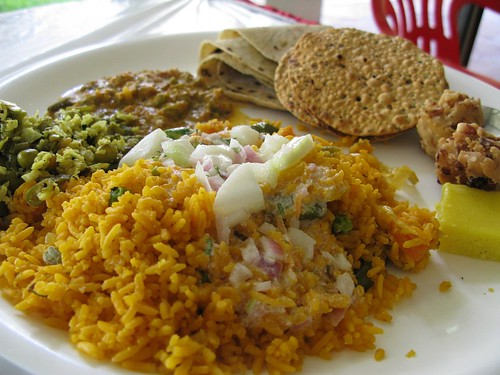
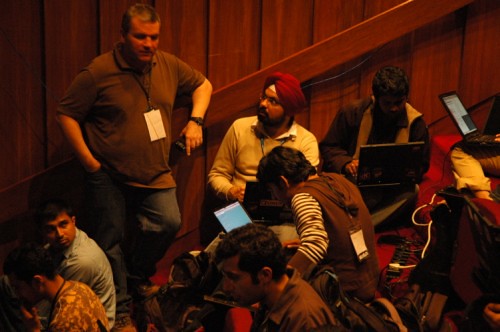
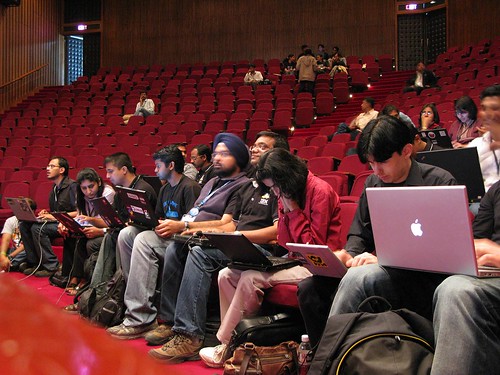
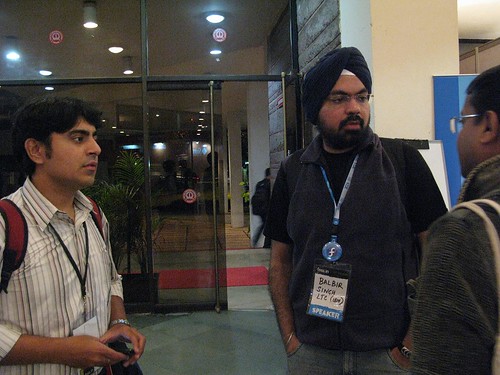
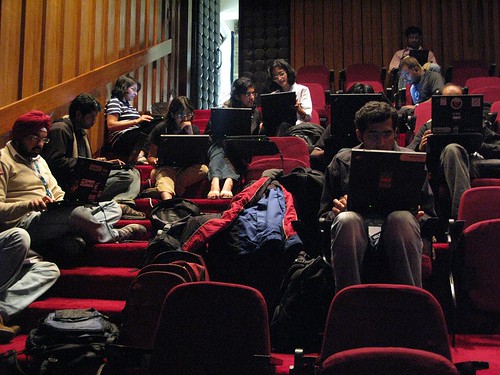
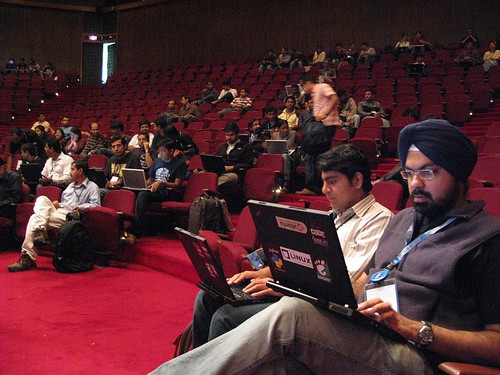
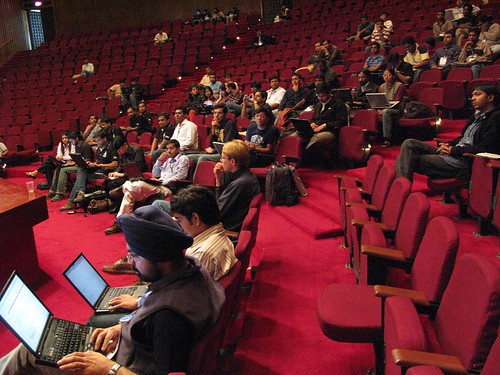
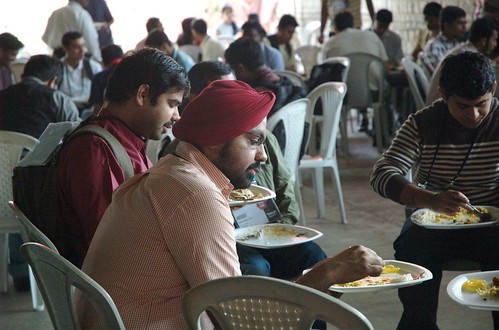
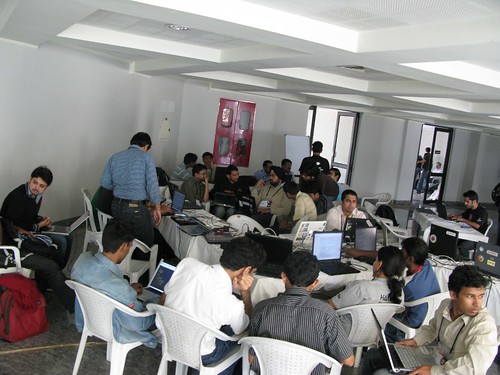
Some photos from FOSS.IN 2009 (more to come)

Friday, November 27, 2009
Gops views on Mumbai 26/11
Friday, November 20, 2009
Smooth upgrade to F12
I was also happy to see my back for resource counter scalability included in F12
(run rpm -q --changelog kernel | less)
* Mon Oct 12 2009 Kyle McMartin
- improve-resource-counter-scalability.patch: Fix scalability issues
on big machines, requested by prarit.
I am all set to sail, kudos to those who helped make Fedora and especially the upgrade path so smooth.
Wednesday, November 18, 2009
Upgrade Journey to Fedora 12
Fedora 12 is out

I use Fedora on my desktop, now more than ever. I am currently well setup on Fedora 11, with 3D graphics (yeah, I can get Secondlife, google earth, etc to work with great speed) setup. Setting up 3D graphics was not easy (but that should be another blog entry. I also have my favourite sound system ALSA setup. I could never get used to Pulseaudio or get it to work the way I like. I am still trying to get webgl to work on my browser. The features in Fedora 12 are too tempting and of course I am already using some of the latest features via rawhide.
I guess its time to plunge into Fedora 12! Do take a look at the release tour of Fedora 12.
Tuesday, November 17, 2009
Thought for the day (Hindi)
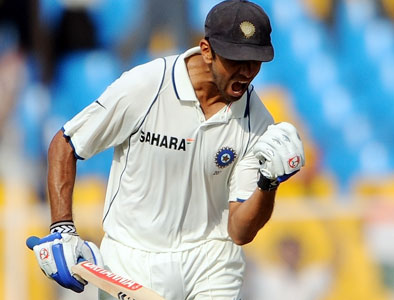
Great Knock Dravid!

(From: cricket.yahoo.com)
I loved this one because of the determination and absolutely wonderful confident stroke play. This knock also got Dravid in the 11,000+ squad (only the 5th cricketer to have that honour). Bravo on the six, the quality of shots and the confidence. Keep the aggression coming Dravid! I love it!
Monday, November 16, 2009
Interesting memory cgroup controller links
- http://www.dmtf.org/svm09/presentation/Corset_Service-oriented_Resource_Management_System_Linux.ppt
- http://www.socallinuxexpo.org/scale7x/sites/scale7x.socallinuxexpo.org/files/openvz-scale7x-resource-management_0.ppt
- http://en.opensuse.org/Cgroup
- http://elinux.org/Memory_Management
- http://tree.celinuxforum.org/CelfPubWik/ELC2009Presentations?action=AttachFile&do=get&target=celf_mem_notify.pdf
- http://www.xtreemos.eu/publications/project-deliverables/d2-1-7.pdf
- http://siena.linux.it/linuxday09/presentazioni/andrea-righi-linux-kernel-hacking-process-containers.pdf
- http://www.linux-foundation.jp/uploads/seminar20081119/CgroupMemcgMaster.pdf
- linuxplumbersconf.org/2009/slides/Dave-Hansen-oom-v3.pdf
Tuesday, November 10, 2009
Bangalore book fair 2009
- Technical books
- Childrens books
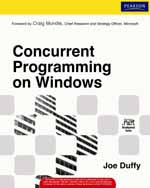
On the technical front, I purchased


It was really nice to see a good number of exciting books for children, I even managed to find some interesting gifts for children I know.
I'd highly recommend visiting the fair, the last day is November 15th
Sunday, November 08, 2009
Thought for the day
Happiness is when what we think, what we say and what we do are in complete harmony
Arguing about OS'es


FOSS.IN first shortlist
Exponentiation
Let the problem be rewritten as raise x to the power n. Let us convert n to binary

Where b0, b1, b2.. bk is the binary representation. Now lets rewrite x to the power n as
This in turn is equal to
The trick is to note that we need to compute even powers of x and determine b0, b1, .. bk. A simple trick is to, check if b0 is odd or even, if it is odd, multiply the current temporary value with x, if it is even, skip b0, but keep squaring the current exponent. Note we keep shifting n right, so that b1, b2,.. ,bk move to position b0 eventually.
Here is the algorithm from Sahni's textbook
def exponent(x, n):
m = n
expx = x
power = 1
while (m > 0):
while ((m % 2) == 0):
expx = expx * expx
m = m >> 1
m = m - 1
power = power * expx
return power
Monday, November 02, 2009
FOSS.IN posters are out


Friday, October 30, 2009
A consumer complains
My experience with [company] today was one of the worst I've had with any product support. I visited [service center] to repair my 15 day old laptop, the display had stopped working. I found that the front desk person opened my laptop without using any static protection mechanism, which I escalated all the way to [somename] (Customer Service Head). I asked for a letter of apology for not following prescribed procedure. [somename] told me it is a human error and I need to ignore it and stop interfering with how [company] service people work (I as a customer was going beyond my boundaries and interfering with their day to day work). After my complaint, the other people started doing the right thing, the local manager said that his employees were tired and just had lunch (hence the error). If [company] can void my warranty (even for opening my laptop, even though I did not (just hypothetically)), why is it OK for [company] service people to *NOT HANDLE* my laptop carefully.
Clearly I am very disappointed and want to see justice done in this matter. All I want so far is a letter of apology for not handling my product and a guarantee that their action has not damaged my laptop
Do you have any experiences to share? Consumer rights are taken for granted and I wish we could be more empowered to take stronger action.
Monday, October 26, 2009
FOSS.IN 2009 coming your way

Friday, October 23, 2009
Finite Automate - solution part I
- Given a binary stream, can we develop a finite automata to calculate the binary number modulo 5?

Question 2 was
- Can we develop a finite automata that can validate the addition of two streams of binary numbers? Does such a finite automata exist?
0 0 1 <- Input2
1 0 0 <- Output
We need to present the string to the automata in the form [1 0 0][0 0 1][0 1 1]. We split the input and output into groups of threes, the last bit (MSB) represents the output. So for example, it says 1+1 is 0 and that is carried over and for the next input 1+0+ 1 (carry) is 0 and1 is carried over again. For the final input 0+0+1(carry) is 1. Hence this language is accepted by the finite automate.
Here is the graphical representation of the solution. In the next blog on FA, I'll discuss the techniques behind these solutions (which are probably very obvious to the reader of this blog anyway)

NOTE: states 7 and 8 are no good, but they are still shown here. Again, 3 is the start state and 3 and 4 are the accept states. The solution can be verified using two inputs and the output in the format specified above
Finite Automata (post one of many to come)
I am going to cover some interesting aspects of Automata in this blog entry
- The exercises in this blog entry to provoke some thought
- Their solutions and representation in the next blog entry
- A software to help solve/validate some of the solutions to the exercises
The exercises I am going to cover are
- Given a binary stream, can we develop a finite automata to calculate the binary number modulo 5?
- Can we develop a finite automata that can validate the addition of two streams of binary numbers? Does such a finite automata exist?
Saturday, October 03, 2009
Thought for the day
Friday, August 21, 2009
Thought for the day
Wednesday, August 19, 2009
Feeling insecure - thoughts on SELinux
I thought I could learn it, wouldn't I be an inferior being if I could not? What does it say about my go-getter attitude? My first encounter with SELinux was when I tried to get ~user/public_html enabled via the Apache Web Server. After I had followed the documentation, I still could not get a seemingly easy feature to work. I dig the web and without knowing too much, I learn about a certain context httpd_user_context_t and use a certain tool and it worked!!!
I had a grin on my face for a few days, I was going to be able to work with SELinux. My next surprise came when I tried to install some software and setroubleshootd very gently pointed me to the cause of the security violation while installing the software and what I could do to fix it (gee, an automated tool, no more worries). My next encouter occurred when I tried to install mediawiki with math enabled (yeah.. I decided to save paper and take notes on the wiki with TeX enabled, but that is a different story). Again, no matter how well I followed the guidelines, I could not get texvc to work :(
Remember to look at /var/log/audit files as root and run audit2allow to get some useful hints with SELinux. SELinux comes with a set of rich GUI tools, be sure to use them as you walk through the seemingly friendly maze of SELinuxI found some help on the mediawiki site that gave me instructions on how to setup SELinux and mediawiki together. To my surprise, I found quite a few software vendors providing additional instructions for setup when SELinux is enabled.
The feeling of being miserable at SELinux set in, I had to now read up and understand the architecture or forgo my new found security infrastructure. Today, I came across a very interesting web page (the wikipedia entry for SELinux),
“...given the threat models and capabilities of the adversaries involved, that's probably appropriate... But that’s not necessarily appropriate for all users. SELINUX is so horrible to use, that after wasting a large amount of time enabling it and then watching all of my applications die a horrible death since they didn't have the appropriate hand-crafted security policy, caused me to swear off of it. For me, given my threat model and how much my time is worth, life is too short for SELinux.” — Theodore Ts’oYou can only imagine how relieved I was to see this quote
Life is too short for SELinuxI was not alone, others hated it and found it hard to use as well. How pathetic can such happiness be, but I was overjoyed, excited to say the least.
My path forward is to continue to use SELinux, but be less tolerant of its idiosyncrasies. I am working my way through the documentation, but very slowly. I've learnt that my new best friend is "Z". Add "Z" to existing commands in Fedora and magically it shows SELinux information that can be a life saviour at times.
Sunday, July 26, 2009
Search engine, BIOS updates and a waste of time
After this blunder, the regular express or ISO based mechanism of BIOS update refused to work. Thanks to the recovery BIOS mechanism on my Intel board, I removed the jumper pins (see manual for your BIOS), put in the CD with .bio file burnt on it.
NOTE:
- .bio is the recover BIOS. Burning
- .bio from Windows burner created a UDF filesystem on the CD, which the failed to work.
I had to force a iso9660 file format from my Linux partition and recover. After the recovery BIOS update, I put back the jumper pins and got back to normal work. My Intel 3D graphics problem on Linux is not yet completely gone, but I do hope to debug it more and not hear back (update BIOS) when I ask for help
In summary, stop believing your search results if you want to be productive :)
Monday, June 08, 2009
No.. I've not given up blogging
I've got a twitter home as well, but twitter is like a light snack and blogging is like a full meal.
Thursday, December 25, 2008
Negative Binomial Coefficient
We know that if
then the sum converges to
Coming from the other side and using binomial theorem we get
which expands to
Which leads to an interesting conclusion

Usually nC2 is used to imply from "n" objects, choose 2 at a time. nC2 gives us the number of total such combinations. What does -1Cn mean? What are the other proofs for -1Cn?
Saturday, December 20, 2008
MUST READ: The Last Lecture

I first heard of the book when I was traveling to a conference with a colleague who wanted to read the book, but wanted to find the best place to buy it. He briefly mentioned what the book was about, which I quickly forgot. I saw it again at several places, until I finally bought it from Strand bookshop in Bangalore. The most famous quote from the book is
“We cannot change the cards we are dealt, just how we play the hand.”
--Randy Pausch
This is one of the few books that I've had several people in my family read partially and love it (they are waiting to finish the full book). The book is about childhood dreams, how to achieve them and also goes a step further and talks about how to help others achieve their dreams.
The book is spectacularly well written, when you begin feel sad for Randy (the Author), there is a twist that will make you feel proud of the way Randy handled himself. The book is about positivity, about never giving up, about believing in humanity, in being true, about family values, about the good in the world, with sometimes what cannot be controlled and must be accepted.
Don't pick this book up as a pity book for Randy, you'll be left pitying yourself after reading everything that Randy did and how he lived his life, leaving us pondering if we've made the best use of our time. Randy focuses on family values, his students, his mentors, his family and there is not a single negative sentiment that he passes on to the readers.
If you are feeling depressed or need something good and small to read, something to boost your moral, to rebuild faith, to appreciate life and the people around you, you must read "The Last Lecture"
Friday, December 19, 2008
Dhoni's belief in Dravid
- Demoting him will put pressure on him, since 3 or 4 wickets would have fallen when he comes in
- He is a good player, who needs some time in the middle
Tuesday, December 16, 2008
FOSS.IN (part 2)

Photo by Sony Phil
The first keynote was from Harald Welte. The keynote was about embedded devices, manufacturers and proprietary Linux trees and their complete ignorance or lack of enthusiasm to contribute upstream. The presentation had information about how vendors were still using old obsolete Linux trees, which had several security flaws and the fixes were not being provided to users. The last keynote was from Kalyan Verma. Unlike the first keynote that lacked a single illustration, this one was full of award winning pictures, FOSS principles applied to other professions and life and also about the environment. How a cup of tea is playing its part in hurting the environment and the stress that we as humans and our requirements is putting on nature. Kalyan also spoke about his previous job as a security expert at Yahoo. He spoke about how cryptography makes no sense and there were obvious security flaws in most implementations. I disagree with Kalyan on some of the things he said about cryptography (like it makes no sense). I think what Kalyan was alluding to, but failed to say was that, security is only as good as the weakest link (a fact known to almost all programmers by now).
Kalyan mentioned that putting up his photographs under creative commons has gone a long way in helping his career. Since the pictures were free to download, they were shared under creative commons, which lead to newer opportunities and work. He went on to say, Pictures are a remarkable form of art. The more you look at them, the more you admire them, which is why sharing his pictures brought in more work and money.
Do check his photographs, they are really cool! James has a good coverage of his keynote as well.
The FOSS.IN team put out a video documentary covering their aspiration for their event and what was achieved. I'd say with FOSS.IN 2008, we've headed in the right direction, probably lost a few people along the way, but we are headed in the right direction. A technical event such as FOSS.IN should focus on contributions and try to encourage and build the mind share for it. Such a direction requires time and patience and also a lot of will power from both attendees and the organizers. We had a drastic change in sponsors this year, but we had them nevertheless, without whom such a large scale operation is hard to carry out.
The food, lunch and snacks were excellent, again James covered it well with photographs and other photographs marked foss.in on flickr. Here are some more memories from FOSS.IN 2008

Photo by Sony Phil

Photo by James Morris

From mdemon

From Sony Phil, photograph from the libcgroup workout
Sunday, December 07, 2008
Lagrange's interpretation in python
Here is the code for interpolation
def lagrange(x):NOTE: Blogger keeps messing up my indentation, I am yet to figure out why.
tmp = scipy.poly1d([0])
result=scipy.poly1d([0])
for i in x.keys():
numerator=scipy.poly1d([1])
denom = 1.0
for j in x.keys():
if (i != j):
tmp = scipy.poly1d([1,-j])
numerator = numerator * tmp
denom = denom * (i - j)
tmp = (numerator/denom) * x.get(i)
result = result + tmp
return result
input = {0:5, 1:10, 2:21}
print lagrange(input)
Sahni's input for the example is {0:1, 1:10, 2:21} and I was surprised to see my program return a different output. Fixing the input, showed the correct results. That reminds me, somebody please ask Sahni to start maintaining useful errata for his books. I searched on the web and found nothing useful.
Running the same algorithm on y = log(x) and input = {1:0, 2:0.3010, 3:0.4771, 4:0.6021}, gave me 00.0123 x^3 - 0.1362 x^2 + 0.6236 x - 0.4997, which corresponds to the cubical approximation of log x (R W Hamming, page 233).
Friday, December 05, 2008
FOSS.IN 2008 Report (Part I)


But... I could not :(
Anyway, the story is not over, even though foss.in for 2008 is. The promos show clearly what the organizers had in mind. I must admit that the organizers make me nervous with the schedule, with selected talks being announced about three weeks before the final event, when I was on vacation. The schedule and slides can be found here. I presented on control groups and organized a workout for libcgroup. Both were well received with significant queries at the end of the talk and good workout participation. We got several patches posted during the workout and after. The workout plan and updates are here.
One of the things we did well this year, was the kernel hacker day at foss.in and followed it up with a successful workout. We had a good number of people come and talk to us about the kernel, their intention to contribute and the issues they face. We admittedly had a plan 9 fan, apart from Christoph Hellwig. There were lightening talks and I spoke about my ideas on building a threaded RB tree for Linux.

There are some fun photos, that several people took. Kushal from Fedora took some very nice ones. He was kind enough to photograph all women and leave me out. Needless to say Kushal, you owe me a T-shirt and I want it now! James Morris, did a good job of taking photographs as well.


One thing that did catch my attention was my T-Shirt with my name on it. I love the T-Shirt and hope it stops choking me, when I wear it, someday :)


You can find James' photo set here.
Lets step back, the event began with a video from team FOSS.IN
Atul has always been a good speaker, he began by explaining the motivation for the change this year and ate an Apple on the stage, claiming that it was only low hanging fruit in the conference and he ate it :) Unfortunately for Atul, we provided other low hanging fruits to developers and allowed people to contribute, even if the contribution was trivial. In the longer run, as foss.in proceeds year and year, I think we'll find the low hanging fruits disappear as the developers mature and our contributions mature.
I'll update on the keynotes, the other speakers and more interesting stuff in part II, stay tuned.
Tuesday, November 18, 2008
Having a bad day?
- Be nice and assertive to the most annoying people around you
- Don't show on your face that you are annoyed, wear a smile
- Remember bad days can end quickly if you are positive and will last for ever if your attitude is negative
- Learn from your bad days, analyze to see what you could have done differently to make them end faster
- Help others around you have a good day, even if you are having a bad day (of course not at your own cost)
Fight back and take bad days away from your life. Remember life is too short to have bad days in them.
Friday, November 07, 2008
Bank of San Serriffe (with branches in Blefuscu and Elbonia on the planet Pincus)
Thursday, November 06, 2008
Time out, take a break, Dravid!
Dravid's dismal form continues in test cricket. He is already out of the one-day squad. When Dravid resigned as captain, he did so to focus on his batting. Unfortunately, Royal Challengers did not work for him (despite his good innings towards the end, when the challenge was already over). His test cricket form has also gone bad. I think it is time to hand Dravid the Ganguly treatment. Drop him from the squad and get him to make a comeback. This is the same thing he and Chappel did to Ganguly and it seemed to work well. I don't want to rule out Dravid for the future, but he seems to be holding up a place that he needs to deserve again. He has a lot of cricket left in him. Seeing his mates Ganguly and Anil must make him nervous, but he should look at Tendulkar for inspiration.
The best way to get back to form is to play domestic cricket and make a good comeback. I hope Dravid will realize that a break is in his favour and the selectors will hand him one.
Saturday, October 11, 2008
The world economy, history and more
1. Look at India's IIP numbers
2. There is a liquidity crunch (banks are not even lending to each other)
3. Unlike last time, we are in a state where need a huge financial bail out
My brother sent an interesting SMS, which read something like
If my bank returns my cheque quoting "Lack of Funds" as the reason. I won't know if the funds were lacking in my account or in the bank
I do believe in the principle that "Money is hardly ever destroyed", why do I say that?
- Wealth is usually created, as we find new resources, work harder, make new products or provide new services
- In general money passes hands and is never destroyed
- Wealth is sometimes destroyed, when we are hit by natural disasters that cause a loss in property, for example
In retrospective from the 2001 recession, web based commerce emerged back stronger and better. The technology, the pricing and the users matured (there were no more freebies for just signing up, BTW, I missed out on all of those :( ). What can expect to see as we come out of this recession? Will banks and insurance, investment companies be smarter? Will there be new regulations to make sure we don't hit such a crisis again?
Looking at the stock market, this is the third slump I've seen and been bitten by, the other two were
- Harshad Mehta's stock scam (I was very small/young then, but I understood what was going on)
- 2001 recession
It is a cycle and we've hit the negative part of the cycle, the positives should be around somewhere, I hope we turn around quickly. Let's hope and pray that we quickly recover back from this situation and become stronger.
Tuesday, September 23, 2008
kernel summit 2008 photo on LWN.net
Saturday, September 06, 2008
Why I have not blogged in a while
I am not carrying a camera this time around, I intend to buy a good cheap camera, that can obsolete itself without making me worry about spending too much money on it. Conferences are usually a great time to get a lot of work done, lets see what this trip does to my productivity :)
Monday, July 14, 2008
Quote of the day
Tuesday, May 27, 2008
Fedora 9 and packaging
Hibernate request refused, the package manager prevented the hibernate operation since it was in the middle on an uninterruptible operation or something similar. I had to manually kill all the packagekit processes and yum before I got the laptop to resume.
I should start filing the BUGS I find into bugzilla soon.
Friday, May 16, 2008
Upgraded to Fedora 9
I often ask myself, why did I upgrade so quickly - as an after thought. The answer is that I like to try new stuff, I am excited by change, new features, the possibility of getting something better quickly. I think that's the open source philosophy as well "Release early, Release often"
The new features do come at a cost though. I had to spend a few hours trying to bring up my X. Nvidia is not supported as an in kernel driver, there is a proprietary driver for it. Here's what I tried
- I used the VESA driver, but I was not happy about the missing graphics acceleration and open GL support
- I tried the nvdia driver from livna, but that had other problems - including complaints about ABI not matching. I tried the trick of starting X with -ignoreABI and setting the option in xorg.conf
- I wanted to try the driver directly from nvidia, but the kernel compile failed. I got patches from nvidia for 2.6.25 and ran into the same ABI issue. Ignoring ABI was not an option, since the shared library module for the nvidia driver uses a symbol that is now missing with the new X that comes bundled with Fedora 9
While configuring the X server, I remembered my first X install (Slackware, around 1999 or 2000). It came with a utility called xf86config, that asked a set of questions and generated a XFree86 configuration file, with a warning that getting the vertical and horizontal frequencies incorrect could fry the video card. Life is much better with Fedora 9, but not all that easy.
Although, I am beginning to like Fedora better than Ubuntu, Fedora's GUI package management sucks. Yumex is the closest thing it has for sane package management, the gnome based pirut, pacakgeit, etc all leave a user wondering what is going on in the background. I would highly recommend installing yumex and using it as the package manager
Fedora 9 comes with a bunch of kernel features - cgroups, cpu controller, cpu accounting controller and the namespace controller. I had a hand in some of these controllers, but unfortunately the memory controller has been disabled.
Fedora 9 comes bundled with FireFox 3 beta 5 (same as Ubuntu Hardy), FireFox 3 seems pretty cool in terms of user friendliness and stability. Downloading updates can be quite painful, unless you happen to know a very good and fast mirror. Most of the times I've tried to download updates, I get an error stating that the mirror is down or "no such file or directory" or "too many users". I guess that is expected since the whole Linux world is trying to get their hands on Fedora 9.
I found printing to be friendlier and more intuitive. I got errors correctly, stating that my printer was running low on ink or there was a paper jam. The print UI seemed quite robust and stable.
I tried KDE4, only to be a little disappointed. KDE4 on Fedora 9 is definitely much better than it is on kubuntu. Settings are well integrated and one has control over KDE4, unlike kubuntu where the controls are still for KDE3. The reason, I was disppointed with KDE was the interactiveness and latency in terms of response. The new UI is flashy, but most of my widgets failed to work (the comic widget and the dictionary widget, for example). The rendering of gtk based applications is quite poor. Most GUI on Linux seems to use the gtk widget library and some use Qt4. Firefox, eclipse, emacs, etc do not look very nice under KDE. These are still early days for KDE4, I hope it will mature soon into something I would want to use.
OpenOffice 2.4 was pleasantly surprising. As always, they seemed to have improved integration with documents and the generated pdf's look really nice. Usability is much nicer and so is the rendering and interactiveness. I would like to give them a thumbs up for this release. The major difference I saw with respect to Ubuntu's Hardy release was that there was no Sun Logo embedded in the splash screen of OpenOffice. I need to see why Hardy has the Sun Logo embedded.
I am glad to see (this was some time back as well) that Adobe and Google now have Fedora yum repositories, which is a very good sign. I wish nvidia would provide similar repositories.
I've just started using Fedora 9, I'll blog more on it, as I experiment and play with it.
Sunday, April 27, 2008
Knuth's recent interview
"The success of open source code is perhaps the only thing in the computer field that hasn’t surprised me during the past several decades. But it still hasn’t reached its full potential; I believe that open-source programs will begin to be completely dominant as the economy moves more and more from products towards services, and as more and more volunteers arise to improve the code
For example, open-source code can produce thousands of binaries, tuned perfectly to the configurations of individual users, whereas commercial software usually will exist in only a few versions. A generic binary executable file must include things like inefficient "sync" instructions that are totally inappropriate for many installations; such wastage goes away when the source code is highly configurable. This should be a huge win for open source.
Yet I think that a few programs, such as Adobe Photoshop, will always be superior to competitors like the Gimp—for some reason, I really don’t know why! I’m quite willing to pay good money for really good software, if I believe that it has been produced by the best programmers."
"I might as well flame a bit about my personal unhappiness with the current trend toward multicore architecture. To me, it looks more or less like the hardware designers have run out of ideas, and that they’re trying to pass the blame for the future demise of Moore’s Law to the software writers by giving us machines that work faster only on a few key benchmarks! I won’t be surprised at all if the whole multithreading idea turns out to be a flop, worse than the "Titanium" approach that was supposed to be so terrific—until it turned out that the wished-for compilers were basically impossible to write."
"The machine I use today has dual processors. I get to use them both only when I’m running two independent jobs at the same time; that’s nice, but it happens only a few minutes every week. If I had four processors, or eight, or more, I still wouldn’t be any better off, considering the kind of work I do—even though I’m using my computer almost every day during most of the day.
So why should I be so happy about the future that hardware vendors promise? They think a magic bullet will come along to make multicores speed up my kind of work; I think it’s a pipe dream. (No—that’s the wrong metaphor! "Pipelines" actually work for me, but threads don’t. Maybe the word I want is "bubble.") From the opposite point of view, I do grant that web browsing probably will get better with multicores"
"On a positive note, I’ve been pleased to discover that the conventions of CWEB are already standard equipment within preinstalled software such as Makefiles, when I get off-the-shelf Linux these days.""I currently use Ubuntu Linux, on a standalone laptop—it has no Internet connection. I occasionally carry flash memory drives between this machine and the Macs that I use for network surfing and graphics; but I trust my family jewels only to Linux. Incidentally, with Linux I much prefer the keyboard focus that I can get with classic FVWM to the GNOME and KDE environments that other people seem to like better. To each his own."
"let me just say that almost everything I’ve ever heard associated with the term "extreme programming" sounds like exactly the wrong way to go...with one exception. The exception is the idea of working in teams and reading each other’s code. That idea is crucial, and it might even mask out all the terrible aspects of extreme programming that alarm me."
"I also must confess to a strong bias against the fashion for reusable code. To me, "re-editable code" is much, much better than an untouchable black box or toolkit. I could go on and on about this. If you’re totally convinced that reusable code is wonderful, I probably won’t be able to sway you anyway, but you’ll never convince me that reusable code isn’t mostly a menace."
Saturday, April 12, 2008
Atomic access
"If you access 64 bit data on a 32 bit machine, what part of the access is atomic?". One would assume that with per-CPU data, it is safe to read the data from a different CPU". The answer lies hidden in the processor architecture. Several RISC architectures require certain types of data to be aligned to specific boundaries (this in turn ensures that the access is atomic). Usually processor manuals suggest that data that is contained within a single cache line is likely to be fetched atomically. Ideally, it is recommended that the data be aligned to the boundary of it's size, so that access is atomic. To explain that further
16 bit data be aligned to a 16 bit boundary
32 bit data be aligned to a 32 bit boundary
64 bit data be aligned to a 64 bit boundary
So the next time you think of atomic access, data sizes, per CPU data, look at your processor manual and determine if the data needs to be protected when accessed from a different CPU.
Wednesday, April 02, 2008
RSS feed is fixed
Feeling left out of the software world
In retrospect, I've been working on concepts that were quite well understood in the 60's and 70's - Virtualization, Resource Management, Processes, Threads, etc. Concurrency is very interesting, specially due to multi-core now being ubiquitous. My TODO list looks very dull - Python, Algorithms, Architecture of so and so processor, etc.
It seems like there is a hard barrier that prevents people stuck in systems from working in the layer above. I feel left and cut-out from the innovation in the application space. While, I am still finishing up on the basic design patterns, the world has already moved on to domain specific patterns. I do feel lost, but there is hope. Hope that someday, I'll take a look on the other side, where the grass seems greener; jump the fence; make sense of the new world; the world that seems to be moving at a rapid pace.
Wednesday, March 19, 2008
Doing my time outside of systems programming
I've just started reading Web Services Essentials. I finished chapter 1, it seemed quite well written and was easily understandable. Unfortunately, the websites listed in the book are no longer accessible. That is quite understandable given that the book was written in 2002.

The other favourite book these days is "C# Precisely". It's a well written compact book. The book consists of 30 sections and you get the feeling that you are learning C# with the least possible time investment. I look forward to putting Mono through the C# precisely test
There are also some other things on my plate that I hope to finish up quickly. I suspect that going through this exercise will give me more debating power to argue for/against technology with my friends and colleagues and also help me appreciate what lies on the other side.
Saturday, March 15, 2008
Ups and Downs from India's Australian Cricket Tour
Up
- India did well without their seniors in the ODIs
- Tendulkar helped India win two finals
- Dhoni led from the front
- Harbhajan Singh managed to dodge charges leveled against him without evidence
- India let Brag Hogg go, even though he used abusive words against the Indian captain
- Bad umpiring was penalized. Steve Bucknor got his well deserved punishment for bad umpiring (long due, he seemed biased against India)
- Hayden was reprimanded for denigrating an Indian player
- Australian public criticized the spirit of the Australian Cricket team for unfair play
Down
- Adam Gilchrist, a well respected cricketer retired
- Michael Clarke got away, even though he tackled Tendulkar in the finals
- Symonds seemed out of form
- Ricky Ponting seemed out of form
- Australian players got away by claiming catches that they really failed to hold on to
- Australian media for looking foolish after every charge they leveled against the Indian team players were waved off
privacy
Some of the policy from the app automation refers to https://rclone.org/privacy/ if you are a general blog reader, follow Google's polic...
-
(Photo from http://content-usa.cricinfo.com/indvaus2008/content/current/player/28114.html) Dravid's dismal form continues in test crick...
-
I've been a big fan of Skiena's Algorithm Design Manual , I recently found my first edition of the book (although I own the third ed...
-
The book is almost out there . There is code and selected solutions as well. The book is supposed to be in full colour from what I heard....